Fire Safety Training for Employees: What Every Workplace Should Cover
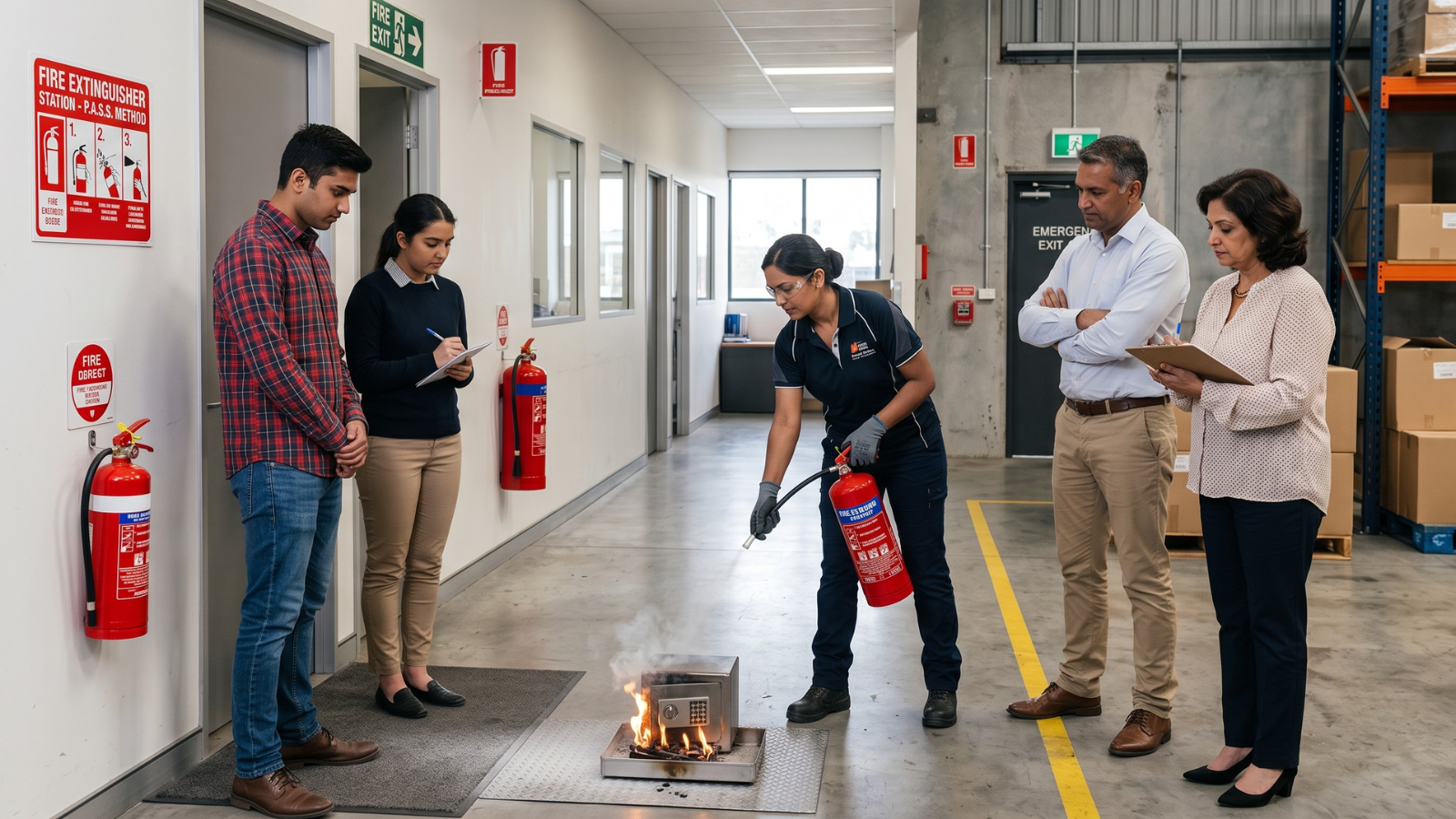
Most Indian workplaces have fire extinguishers on the wall and an evacuation map near the lift. Far fewer have employees who actually know how to use either one under pressure. Fire safety training for employees in India is a legal expectation under the National Building Code and state factory rules, but treating it as a compliance checkbox misses the point. Training is what determines whether a small fire stays small.
Why Training Matters More Than Equipment Alone
Fire suppression equipment only works if the person nearest to it knows how to use it in the first thirty seconds of an incident. That window is when a fire is still small enough for an extinguisher to matter. Once it grows past that point, the only correct response is evacuation, and employees need to recognise that shift in real time rather than freeze or hesitate.
What a Complete Training Program Should Cover
|
Training Component |
What It Should Include |
|---|---|
|
Fire prevention basics |
Common ignition sources, safe storage of flammables, electrical hazards |
|
Extinguisher use |
Fire classes, correct extinguisher type, hands on practice |
|
Evacuation procedures |
Primary and secondary exit routes, assembly points, headcounts |
|
Role-specific duties |
Fire wardens, first responders, department leads |
Each of these needs to be revisited periodically rather than delivered once during onboarding and forgotten. A layout change, a new floor, or a new set of hazardous materials on site is reason enough to refresh the training rather than wait for the annual cycle.
Fire Extinguisher Training Specifically
Not every fire responds to the same extinguisher, and using the wrong type can make an electrical or grease fire worse rather than better. Employees expected to respond to incipient stage fires should know the difference between Class A, B, C, and electrical fires, and which extinguisher on your premises corresponds to each. This is also where hands-on practice matters far more than a slide deck. Pulling the pin and aiming at the base of a fire under supervision builds muscle memory that a lecture cannot. Facilities stocking their own fire suppression equipment should schedule this practical component alongside their annual maintenance checks so both happen together.
Evacuation Drills That Actually Prepare People
A fire drill that happens at the same time every year, announced in advance, teaches employees very little. It confirms that the exits are unlocked, which is useful, but it does not test whether people know the route from their actual desk or workstation. Vary the drill timing and starting point occasionally, and use it to confirm that headcounts at the assembly point are accurate and fast.
Secondary evacuation routes deserve equal attention. Most employees only ever use the main exit they walk through daily, and in a real incident that route may be blocked by smoke or the fire itself. Walking the secondary route as part of training, not just describing it on a poster, is what makes it usable under stress.
It also helps to debrief immediately after every drill while details are fresh. A short five minute discussion covering what went smoothly and what caused confusion gives the next drill a clear improvement target, rather than repeating the same exercise without ever addressing the friction points employees actually experienced.
Assigning Role-Based Responsibilities
General fire safety training applies to every employee, but a subset needs deeper responsibility. Fire wardens on each floor should know how to do a final sweep before evacuating, how to assist employees with mobility needs, and how to communicate with the assembly point coordinator. HR teams typically own the training calendar and attendance records, while facility managers own the physical readiness of exits, alarms, and extinguishers. Splitting these responsibilities clearly avoids the common gap where everyone assumes someone else is tracking compliance.
Recordkeeping and Compliance
Fire NOC renewals and internal audits both typically ask for drill history and training attendance records. Keeping a simple log of who was trained, when, and on what content is far less work than reconstructing that history under pressure when an inspector asks for it. This kind of documentation, according to guidance on fire safety compliance requirements in India, is treated as evidence of an active safety program rather than a one-time exercise, which matters both for compliance and for insurance purposes.
Building Training Into the Employee Lifecycle
New employees should receive fire safety orientation before their first week ends, not months later as part of a generic annual refresher. For existing staff, tying refresher training to a fixed point in the year, alongside extinguisher servicing or fire risk assessments, keeps it from slipping down the priority list. Facilities managing their own inventory of extinguishers, signage, and suppression systems benefit from reviewing their current fire safety product range at the same time they schedule training, since gaps in equipment often surface once staff start asking practical questions during a session.
Choosing Between In-House and External Training
Some organisations run fire safety training entirely in-house using facility managers or safety officers who are already familiar with the building layout. Others bring in certified external trainers, particularly for the hands-on extinguisher component, since live demonstrations require equipment and supervision that many offices are not set up to provide internally. A blended approach works well for most mid-sized workplaces, in-house sessions for evacuation routes and role assignments, paired with an annual external session for practical extinguisher use and updated regulatory guidance.
Whichever approach you choose, confirm that the trainer or program references current NBC provisions and any state-specific fire rules that apply to your building category, since guidance does get revised and a training program built on outdated material can leave real compliance gaps.
Selecting and Preparing Fire Wardens
Fire wardens should be chosen for reliability and calm decision making under pressure, not simply seniority. Ideally, assign at least one warden and one backup per floor or department, since relying on a single person creates an obvious gap if that individual is on leave or travelling when an incident occurs. Warden training should go beyond the general employee session and include a walk-through of the specific evacuation sweep responsibilities, communication protocols with the assembly point, and how to assist colleagues who may need extra support during an evacuation.
Measuring Whether Training Is Actually Working
Attendance numbers alone do not confirm that training is effective. A better measure is drill performance, how quickly a floor reaches its assembly point, whether the headcount is accurate on the first attempt, and whether employees can correctly identify their nearest two exits when asked without warning. Some organisations run a short, informal quiz a few weeks after each training session to catch gaps early rather than waiting for the next scheduled drill to find out retention was low.
Feeding these observations back into the next training cycle, rather than repeating the same session unchanged every year, is what turns a compliance requirement into a program that genuinely improves workplace safety over time.
Making Training Stick
Training that happens once a year in a conference room rarely translates into confident action during an actual emergency. Short, more frequent refreshers, hands-on extinguisher practice, and drills that vary in timing and scenario do more to prepare a workforce than a single comprehensive session ever will. For HR teams and facility managers building or refreshing a program this year, the goal is not just to satisfy an audit checklist but to have employees who know exactly what to do in the first minute of an incident, because that minute is usually what decides the outcome.